.jpg)
Bloomsday 2026 — “Think you’re escaping and run into yourself. Longest way round is the shortest way home.“
- Jun 16
- 4 min read
Updated: Jun 18

Around the world, readers gather to celebrate Bloomsday. Passages are read aloud in Dublin, Zürich, Trieste, Paris, New York and countless places in between.
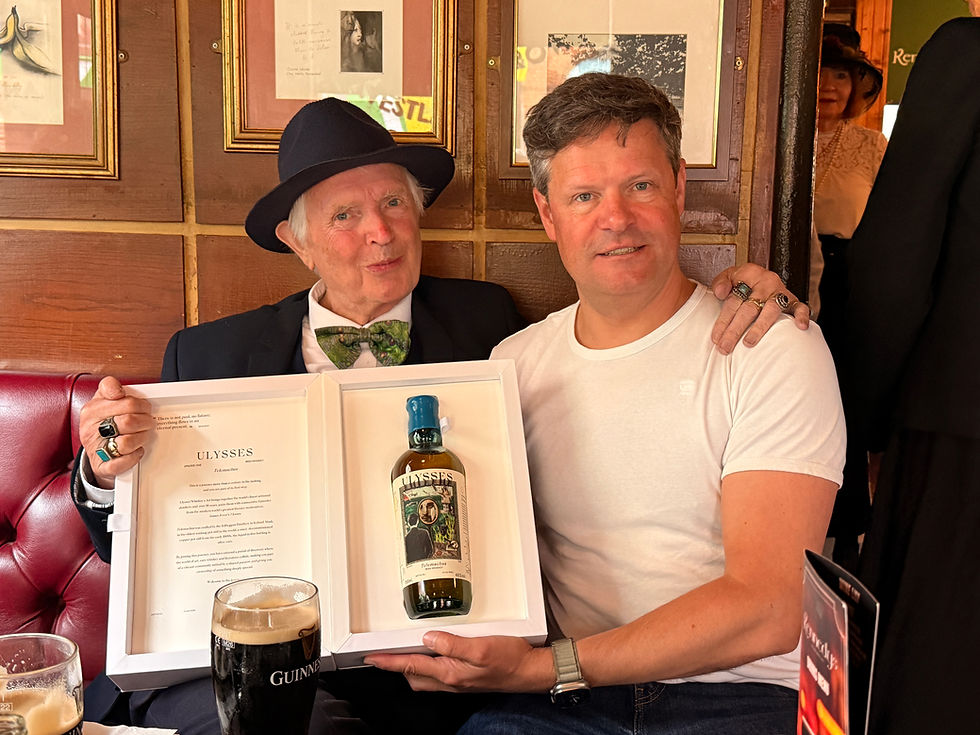
I had the very good fortune of celebrating again with friends in my native Dublin today. We visited Sweny's Pharmacy, the National Gallery, Kennedy's Pub, The Bailey Bar & Cafe, Davy Byrnes, Ulysses Rare Books and a fascinating impromptu meeting of the minds at The Oriel Gallery.

This Bloomsday we were due to release Episode 3 — Proteus — the third chapter in our eighteen-year journey through James Joyce's Ulysses. Instead, I found myself wandering rather further than expected into the remarkable world of Philip Syng, the Irish-American silversmith whose work became intertwined with Episode 2. You see, we needed an inkwell for the teachers desk on our label for Nestor...
What began as research became fascination, which soon became obsession. And before I knew it, the tide had carried me off course. The image of the inkwell is only cca 3x4mm on our label, but absolutely worth it! Like so many of the figures who populate Joyce's world, Syng proved impossible to understand in a single sitting. One discovery led to another, and before long I found myself happily lost in the company of a man whose work helped shape history.
Born in Ireland, Philip Syng emigrating to Philadelphia aged eleven, in the early eighteenth century. He became one of colonial America's most accomplished silversmiths, a close associate of Benjamin Franklin, and a respected civic leader.
His masterpiece, the Syng Inkstand of 1752, would later be used in the signing of both the Declaration of Independence and the United States Constitution (see below on the desk)...

The story took an unexpected turn when I found a silver spoon Syng had made, which was a wedding gift to a couple in 1767. Their surname began with "W", his first name with "S" and hers with "A"... so far, so normal. It got very weird when I discovered in a close-up that the spoon was later gifted to a certain "Paul" in 1872.
“Think you’re escaping and run into yourself. Longest way round is the shortest way home.“
As predicted by Joyce, the line is spoken by Stephen Dedalus in Episode 3 — Proteus. The idea is that all the detours, delays, and wanderings we take eventually bring us back to ourselves; the apparent long route is, paradoxically, the true route home.
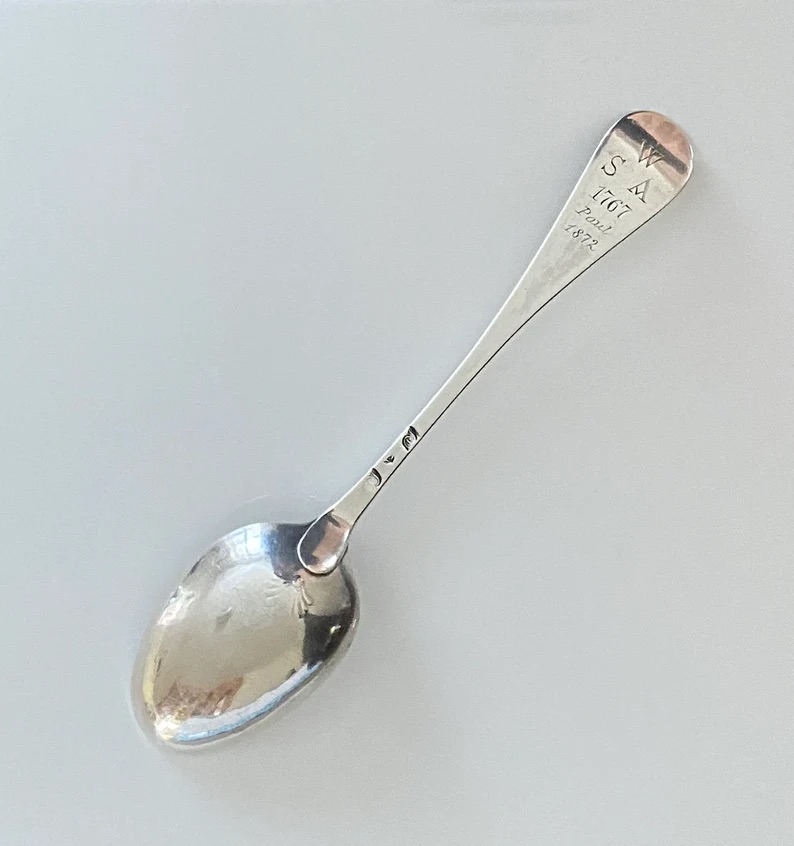
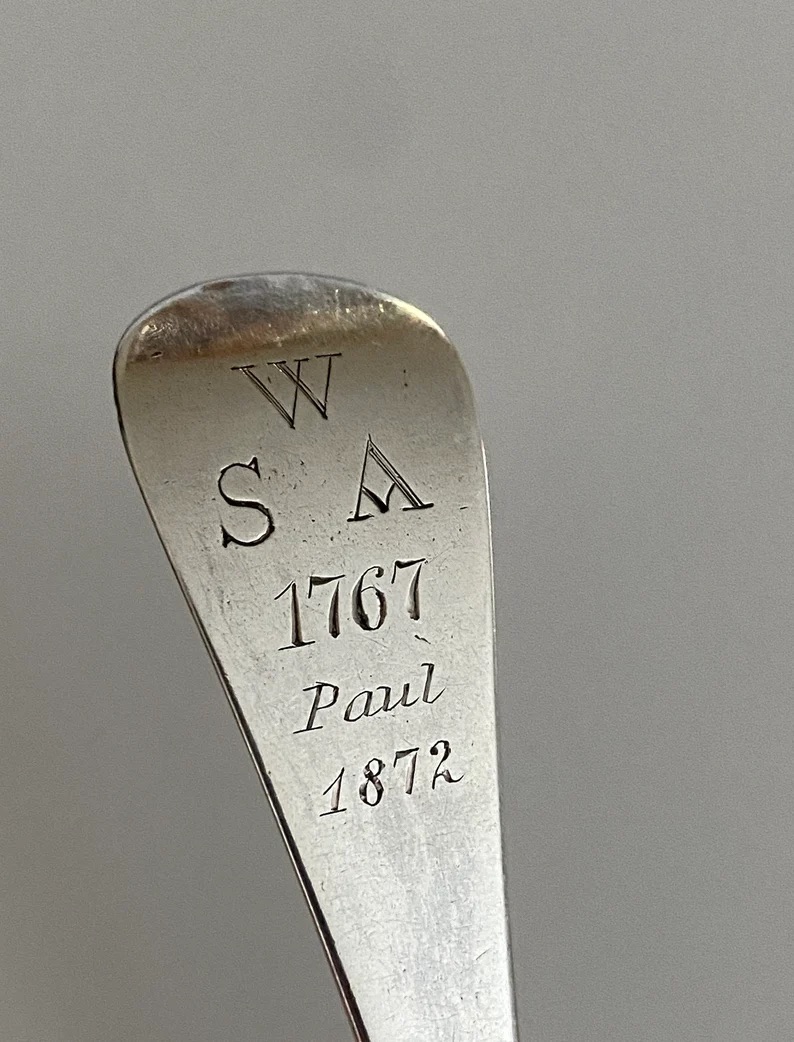
To summarize, (I will write the complete version some day!), Philip Syng had a famous grandson, Philip Syng Physick the "Father of American Surgery", otherwise it appears the family died out, and there is no Philip Syng company to speak of either... so... we decided to register the trademark and have every intention of re-establishing the Philip Syng Irish-American Silversmith Company. Perhaps with a collection of silver barware? Much to do!

If there is any chapter of Ulysses that can forgive a delay, it is Proteus. At eleven o'clock on the morning of June 16th, 1904, Stephen Dedalus walks alone along Sandymount Strand. The classroom and certainties of Nestor are behind him. Ahead lies the shifting edge between land and sea. The strand becomes a stage for memory, philosophy, language and imagination. Thoughts arrive and disappear like waves. One moment Stephen reflects on Aristotle and Aquinas; the next he recalls Paris, his family, his mother's death, fragments of poetry, snatches of foreign languages, and observations so ordinary that they border on the absurd. Like the sea-god Proteus from whom the episode takes its name, the chapter continually changes shape.
It is one of the most challenging episodes in Ulysses, and one of the most rewarding. Joyce abandons conventional narrative and immerses us directly in the restless flow of consciousness. The result is a chapter that continues to puzzle, delight and challenge readers more than a century after it was written.
In many ways, Proteus reminds us that journeys rarely proceed in straight lines. Joyce himself knew this better than most.

Long before Ulysses became celebrated as one of the great novels of the twentieth century, it struggled to find a publisher at all. Early episodes appeared in The Little Review in New York, where publication was interrupted by obscenity prosecutions. Printers hesitated. Publishers declined. The manuscript travelled, stalled, resurfaced and travelled again.
It was only through the extraordinary determination of Sylvia Beach, founder of Shakespeare and Company in Paris, that Ulysses finally appeared in book form on Joyce's fortieth birthday: 2 February 1922.
The path from manuscript to masterpiece was neither direct nor certain. Like Stephen on the strand, Joyce himself spent years navigating shifting ground.
Perhaps every worthwhile undertaking encounters its own tides?
As we prepare Episode 3 - Proteus, I am reminded that patience is not the enemy of progress. Sometimes the journey wanders. Sometimes it circles unexpectedly. Sometimes the most interesting discoveries are found in the detours.
Thank you for your patience, and welcome to the journey!


Comments